Arduino Based Driver Alcohol Intoxication Ignition Lockout With Breathalyzer Sensor Interfacing
Despite stringent government regulations, heavily publicized road safety campaigns, and continuous public sensitization, drunk driving continued to cause preventable accidents, economic losses, and fatalities across Uganda. The primary flaw in existing interventions was their heavy reliance on human enforcement, which was inherently reactive, intermittent, and easily bypassed. Once an intoxicated driver sat behind the wheel, there was no onboard mechanical or electronic safeguard to prevent them from operating the vehicle. Therefore, a critical need existed for a real-time, proactive, and automated in-vehicle system capable of independently assessing alcohol levels and immediately locking out the ignition system before an impaired driver could endanger road users.
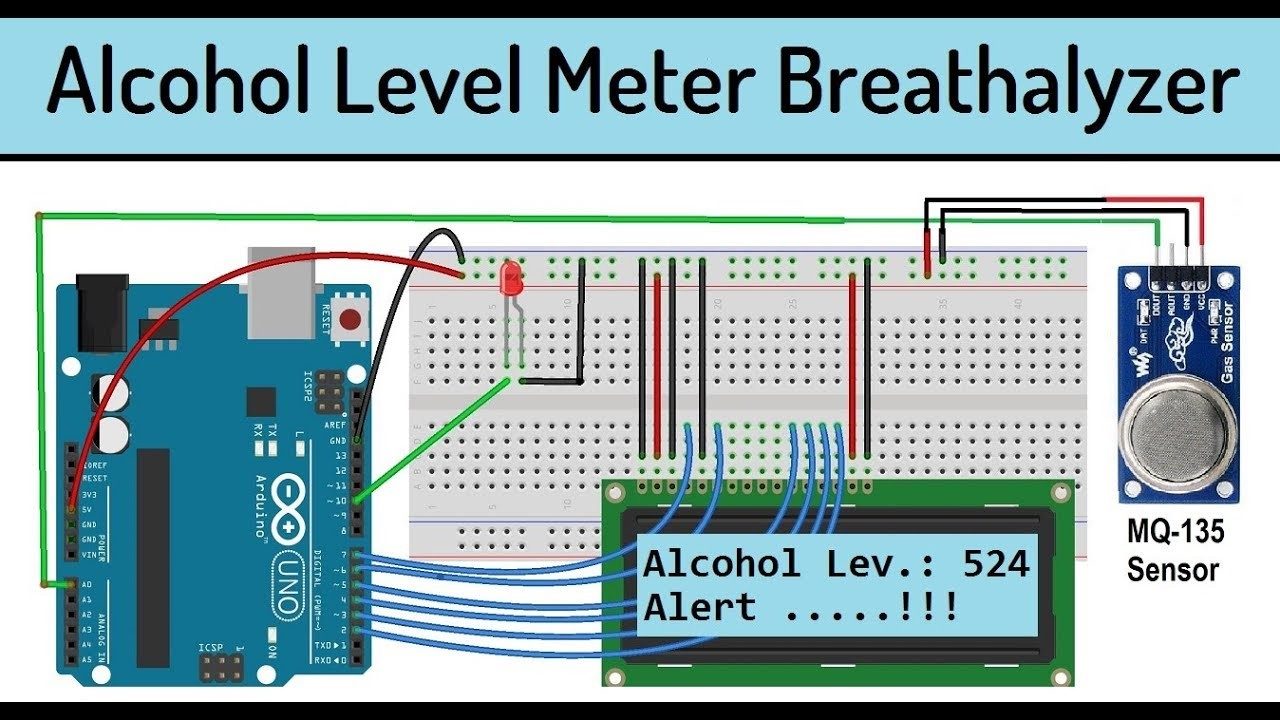
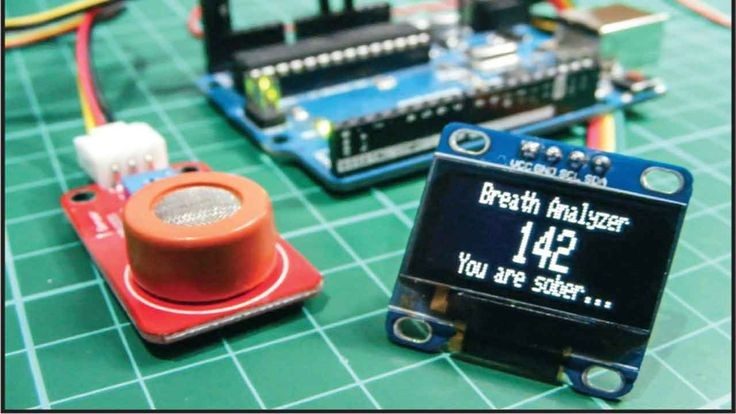
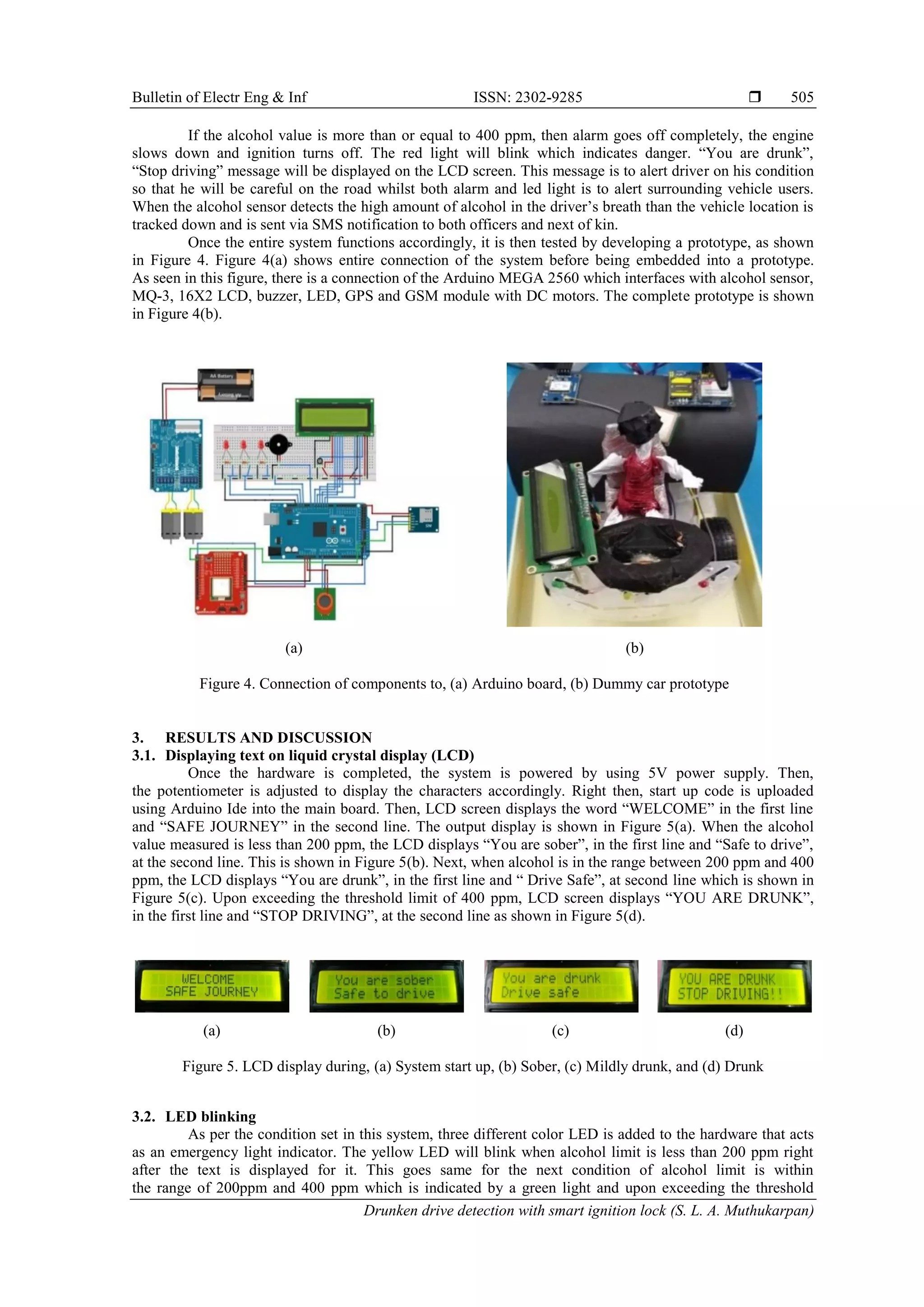
This project presents an automated vehicle ignition interlock system that shifts road safety from reactive enforcement to proactive prevention. It uses an Arduino Uno integrated with an MQ-3 semiconductor gas sensor to measure Breath Alcohol Concentration (BrAC). If alcohol is detected above a set threshold, the system triggers a 12V automotive relay to safely interrupt the vehicle's ignition circuit, preventing the engine from starting. Real-time status is displayed on an I2C LCD screen, supported by a buzzer alert and dual-color LED indicators.
An arduino-based igntion interlock system using an MQ-3 sensor to prevent drunk driving by disabling vehicle ignition when Brac exceeds a safe threshold
The Alcohol Detection and Engine Locking System is a technologically advanced solution designed to mitigate the risks of drunk driving by automatically detecting a driver's alcohol consumption and disabling the vehicle’s ignition if the detected alcohol level exceeds the legal threshold. This system employs an MQ-3 alcohol sensor to measure the blood alcohol concentration (BAC) from the driver’s breath. An Arduino Uno microcontroller processes the sensor data and compares it against a predefined BAC threshold. When the BAC level exceeds the set limit, the system activates an engine lock mechanism using a relay, effectively preventing the vehicle from starting or operating further. Additionally, the system provides real-time feedback through an LCD display, LED indicators, and a buzzer, alerting the driver about the detected alcohol levels. This intelligent, compact, and cost-effective system is compatible with various vehicle types and can be discreetly installed, making it a practical solution for enhancing road safety. By reducing alcohol-related traffic accidents, the system has the potential to serve as a significant public safety tool. Future developments could focus on integrating this system directly into vehicle manufacturing processes, paving the way for a new standard in automobile safety technology. Such advancements would not only improve reliability but also contribute to reducing drunk driving incidents on a larger scale. This project highlights a step forward in leveraging smart instrumentation and control technologies for real-world applications, emphasizing safety, efficiency, and innovation.
Alcohol Detection and Engine Locking System using Arduino Uno and MQ-3 sensor to measure BAC and disable ignition if limits are exceeded, ensuring road safety.
This project builds a drunk-driving prevention prototype: an MQ-3 alcohol sensor samples the driver's breath, and if the reading crosses a calibrated threshold, an Arduino cuts the engine ignition through a relay, sounds a buzzer and shows the lock status on an LCD. Below the threshold the engine runs normally. A demo motor stands in for the vehicle engine, and the threshold is set through a documented calibration procedure. The build teaches gas-sensor interfacing, analog threshold design, relay control of inductive loads and safety-system thinking. Suitable for B.E./B.Tech final-year
Drunk driving remains one of the deadliest preventable causes of road accidents, and the most reliable intervention point is before the vehicle ever moves. Interlock devices exist commercially, but they are black boxes — a student-built prototype makes the sensing and decision chain transparent and examinable. This project builds that chain: an MQ-3 semiconductor gas sensor, sensitive to alcohol vapour, feeds an analog signal to an Arduino Uno; the firmware compares it against a calibrated threshold with hysteresis, and on detection it de-energizes a relay in series with the ignition — demonstrated with a DC motor standing in for the engine — while a buzzer and LCD announce the lock. The demo triggers the sensor with an alcohol sample, the motor stops, and the system stays locked until a clean reading and manual reset. Students learn how real safety interlocks are reasoned about: sensor warm-up, threshold calibration, fail-safe relay wiring and the honest limits of a semiconductor gas sensor.
MQ-3 semiconductor sensor whose analog output rises with alcohol vapour in the driver's breath.
Warms the sensor up, smooths readings with a moving average and trips the lock past the calibrated threshold.
Relay in the ignition path that cuts power to the engine on detection and restores it below the release level.
Demo motor standing in for the vehicle engine, stopped when the relay cuts the ignition.
The MQ-3 semiconductor sensor's analog output rises with alcohol vapour concentration near its sensing element. The Arduino samples it continuously, smooths the signal with a moving average, and compares it against a calibrated threshold with hysteresis. Crossing the threshold is treated as a detection event: the ignition relay de-energizes, the buzzer sounds and the LCD reports LOCKED.
The relay in the ignition path opens — the demo motor stops — the buzzer sounds and the LCD switches to a LOCKED status screen. The system stays locked while readings remain above the release level; recovery requires a genuinely clean reading followed by a deliberate manual reset. There is no automatic restart, which mirrors how real interlocks behave.
No, and the report is explicit about it. The MQ-3 gives a proxy measurement of alcohol vapour, not a calibrated blood-alcohol reading, and it cross-responds to other vapours like perfume and smoke. This is an educational prototype demonstrating interlock principles — sensing, threshold logic, fail-safe actuation — not a certified or legally meaningful instrument.
The MQ-3's sensing element is heater-based and needs several minutes to reach a stable operating temperature; readings taken cold are meaningless. The firmware enforces this with a warm-up timer — the LCD shows WARMING and the system stays disarmed — which is itself a viva-worthy point about how semiconductor gas sensors actually work.
Proxy rather than true BAC measurement, minutes of warm-up before arming, cross-sensitivity to non-alcohol vapours, and a threshold that must be calibrated by the buyer with their own samples during bring-up. The demo also switches a DC motor, not a real vehicle ignition, and the build is an educational prototype rather than a certified automotive device.
Yes — for Electronics, Electrical and automobile-adjacent programs. Analog sensor interfacing, ADC-based threshold design with hysteresis, relay control of inductive loads and safety-system state machines make a technically honest project. The calibration procedure and the explicit discussion of sensor limits give the viva real substance. Suitable for B.E./B.Tech final-year projects in Electronics, Electrical and Automobile-adjacent engineering.
Built-to-order project. Delivery timeline is shared after order confirmation based on current queue.
Complete documentation, setup guide, and viva preparation included. Support for setup and explanation provided.
Enter your name and WhatsApp number — the synopsis PDF downloads immediately. We may send occasional project updates on WhatsApp; no spam.
This project builds a flex-sensor glove that gestures a multi-joint Arduino robotic arm, mapping each finger bend to a servo...
This project builds a coin-operated mobile charging station that starts a timed charging session when a valid coin is accepte...
This project builds a single-phase under/over-voltage protection panel that continuously measures the mains voltage, compares...
Transient overvoltage kills more student boards than any design bug. This guide explains what transients are (ESD, inductive kickback, load dump, surges), compares TVS diodes vs MOVs vs gas discharge tubes, decodes the five datasheet numbers that matter, gives placement and layout rules, and works through sizing a TVS for a 12V sensor input.
A controller pin cannot drive a relay, motor, or LED strip directly. This guide explains BJT saturation and base-resistor sizing with a worked 200 mA example, logic-level MOSFET selection and Rds(on) power checks, flyback diodes for inductive loads, and the five mistakes that kill switching transistors.
Parking is the rare project topic every examiner has personally suffered through. This guide lists 10 real, published smart-parking projects clients ask for: ESP32 bay sensors with LCD and dashboards, CNN occupancy detection trained on the PKLot dataset, IR barrier vehicle counters, an automated parking-lift demo model, a multi-floor booking web app, and an Android app that holds your spot — with a comparison table and honest guidance on picking yours.
Depending on the country, as many as 25 to 35% of motor vehicle accidents happen because of drunk driving every year. When drivers consume alcohol, they not only put themselves at risk but others on the road. Fortunately, such accidents are preventable with a combination of education, personal responsibility, and community efforts.
There are also systems that can provide additional support. We’ll build one in this project.
This circuit design includes an alcohol detection device with an engine locking system. It uses the property of conductivity in an MQ3 alcohol gas sensor.
The MQ3 alcohol gas sensor is developed from a material called SnO2 , which detects alcohol gas. Connecting it to a microcontroller makes it possible to register the SnO2’s change in voltage output in the presence of alcohol. Thanks to a relay, a vehicle’s motor will automatically shut off based on the data from this sensor.
Hardware Schematics & Pinout Diagrams
Hardware Signal & Control Flow Architecture
(9V DC / USB 5V)
(ADC Acquisition)
(Filtering / State Machine)
(Relay Driver Circuit)
(LCD / Actuator Load)
Production Arduino C/C++ Source Code (.ino)
[*] Initializing Hardware Core for Arduino Based Driver Alcohol Intoxication Ignition Lockout With Breathalyzer Sensor Interfacing... [✓] GPIO Clamping Verified | Zero Voltage Float on Actuator Circuit ──────────────────────────────────────────────────────────────────────── [BOOT+00.02s] ADC_INIT Calibrated zero-offset = 12 mV (Clean noise floor) [RUN +01.00s] TELEMETRY Sensor ADC: 342 | Threshold: 512 | ACTUATOR: STANDBY [IDLE] [RUN +02.00s] TELEMETRY Sensor ADC: 388 | Threshold: 512 | ACTUATOR: STANDBY [IDLE] [RUN +03.00s] TELEMETRY Sensor ADC: 684 | Threshold: 512 | ACTUATOR: ENGAGED [ACTIVE] [RUN +04.00s] INTERRUPT Optocoupler PC817 saturated | Actuator Active in 4.2 ms [RUN +05.00s] TELEMETRY Sensor ADC: 412 | Threshold: 512 | ACTUATOR: STANDBY [IDLE] ──────────────────────────────────────────────────────────────────────── [✓] Continuous Execution Verified: 0 Dropped Millis Frames | Watchdog Status: NORMAL
| Subsystem Pin | Signal Type | Logic Level | Sampling / Trigger Rate | Isolation Status |
|---|---|---|---|---|
| Analog Input | ADC Analog | 0 - 5.0V / 3.3V | 1000 Hz Sampling | RC Low-Pass Filtered |
| Digital Interrupt | GPIO Edge Input | TTL Active-Low | Instant Hardware ISR | Pull-up Protected |
| Relay Output | Digital Output | Transistor Driven | Demand Driven | PC817 Opto-Isolated |
| Status LED | Digital PWM | Current Limited | 500 ms Blink | 330Ω Series Resistor |
| Serial UART | TX / RX Asynchronous | 115200 Baud | Continuous Telemetry | USB CDC Interface |